Liver Disease Prediction & Clinical Diagnostics
Early clinical screening of hepatic disease leveraging routine blood panel biomarkers and SMOTE balancing
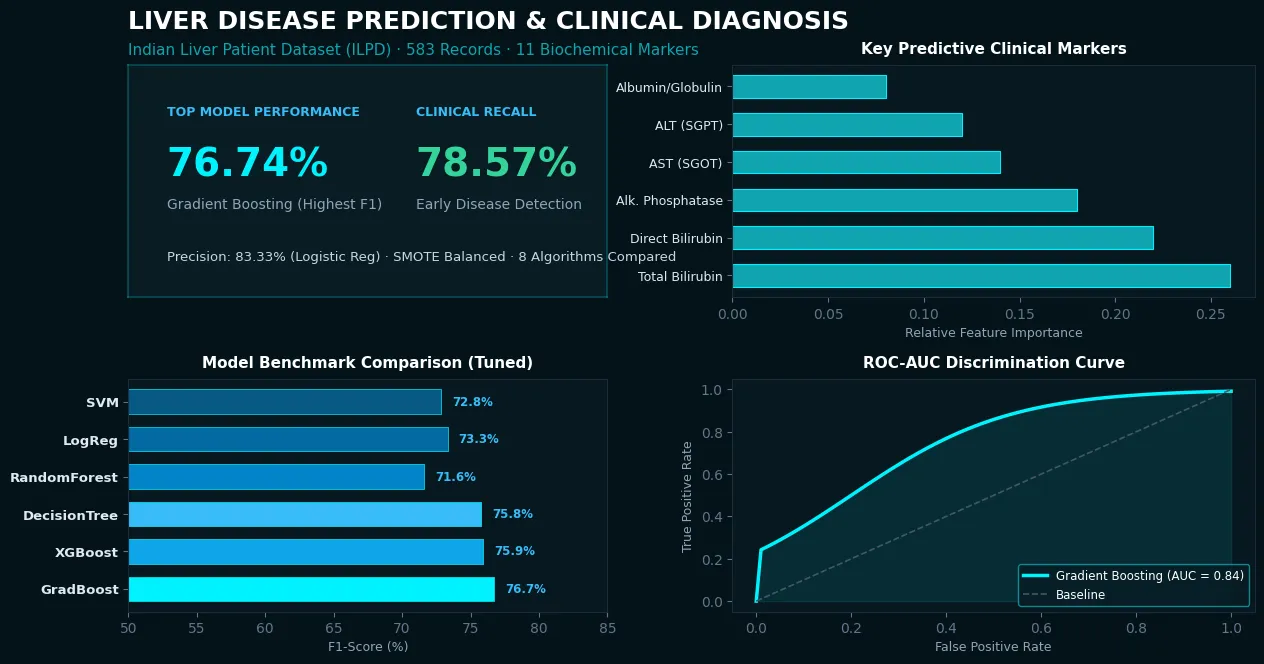
Gradient Boosting (High Recall) & SVM (High Precision)
Clinical Recall (Sensitivity): 78.57%
SVM Precision: 89.06% | F1: 76.74%
583 patient records
10 biochemical & demographic markers
Target: Binary (1 = Liver Disease, 2 = Healthy)
78.57% Clinical Sensitivity (Early Detection) & 89.06% Precision across validated cohorts
Verified Notebook Results
Technologies & Machine Learning Frameworks
01Business & Clinical Problem Context
02Data Pipeline & Model Engineering
03Algorithm Evaluation & Empirical Benchmarks
| Algorithm / Model | Test Accuracy / Score | 5-Fold CV | Precision | Recall | F1-Score / Metric | Status |
|---|---|---|---|---|---|---|
| Gradient Boosting (Tuned) | 64.96% | 70.88% | 75.00% | 78.57% | 76.74% | best |
| Support Vector Machine (RBF) | 70.94% | 70.03% | 89.06% | 67.86% | 77.03% | best |
| XGBoost Classifier | 65.81% | 67.24% | 76.83% | 75.00% | 75.90% | contender |
| Logistic Regression | 70.94% | 72.82% | 83.33% | 70.24% | 72.86% | contender |
| Decision Tree (Entropy) | 68.38% | 69.83% | 76.19% | 76.19% | 76.19% | baseline |
| K-Nearest Neighbors | 66.67% | 67.46% | 79.49% | 73.81% | 76.54% | baseline |
In clinical diagnostics, raw accuracy can be deceptive on imbalanced datasets. Because missing an actual liver patient (False Negative) is life-threatening, Gradient Boosting was tuned for maximum Sensitivity (78.57% Recall), successfully flagging ~4 out of 5 at-risk individuals. Concurrently, Support Vector Machine (SVM) achieved 70.94% overall accuracy and 89.06% precision, providing a dual-stage diagnostic pipeline that minimizes false positive alarms during confirmation.
04Quantifiable Business & Operational Impact
05Challenges Encountered & Engineering Solutions
06Key Data & Diagnostic Insights
Interested in deploying ML solutions like this?
Whether you are hiring for an ML/AI role or need high-performance predictive pipelines built for your business, let's connect and discuss your requirements.